- The Mysterious Disappearing Tattoo Guy of Lyndhurst

⚠️ Content warning: catfishing, scams, pornographic images and discussion of sex.
Now I’m single, I’m on a few hookup/dating apps.
On one of them, the same profile image is used for a variety of accounts. The very handsome Crown Prince of Dubai. I didn’t know who he was until the same photo started to appear on different accounts. Sometimes I would actually be having two conversations with the same face. I don’t hide my face, so clearly there are multiple bots that don’t talk to each other.
I always report and block. It’s about the only thing that I can do to try to protect my fellow app users from this scammer.
But, I guess that once in a while the scammers manage to hook somebody, otherwise they wouldn’t keep doing it.
Tonight, a rather handsome face said “hello” to me. Whoever was approaching me could have taken a dream man out of my imagination and created him in pixels.
But there was something familiar about him. I felt as though I’d seen him before somewhere.
This guy said that he was about five miles away from me, in a town in the New Forest called Lyndhurst.
How exciting!
He was twelve years younger than me; even if I was looking for a relationship, he’d be too young for me. But friends – or friends with benefits – fuck yeah! He was fine with that.
I felt thrilled!
Then he asked to move to a different app. To be fair, that’s not a red flag because some of the messaging features in these apps are pretty bad. But it did make me feel more cautious.
Then I found where I’d seen him before. A porn video. It was him … right down to the tattoo.
I grabbed a screenshot and sent it to him.
On reflection, that could have been a terrible thing to do to somebody – if they were real! Imagine how I would feel if some stranger had got hold of one of my “sex tapes”. Mind you, it might also be a bit thrilling to know that somebody had got off on one of my videos! Ahem.
He claimed that it was a fake video and asked me to delete it.
I hesitated.
I wanted to test this more.
I took a photo of me and the dog on the sofa. It wasn’t a flattering picture, it was a little blurry – but it was real.
I then asked him to send a picture of himself exactly as he was right now.
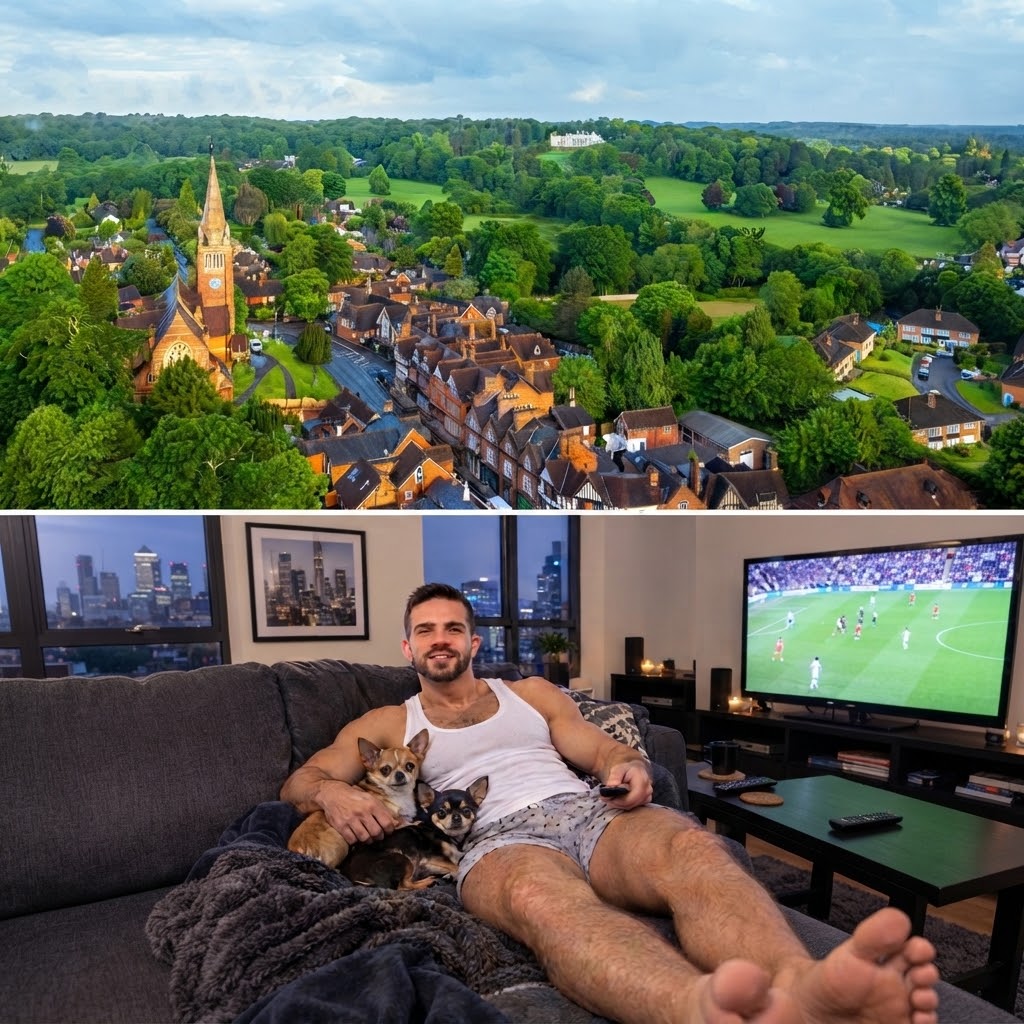
He went quiet for a few minutes, then sent an immaculate picture of “himself” in an apartment cuddling two dogs.
There were a few things wrong with the picture.
Lyndhurst is a small town. There are no glittering skyscrapers.
Football was on the television. Nothing wrong with that – I have heard that there are some peculiar homosexuals who actually enjoy football. What was off was that the sofa didn’t face the telly.
Finally … the tattoo was missing.
I thought that I might play with him for a little longer – but then I thought that if I point out the things that alerted me to him being a fake might cause him to clean up his act … which might make it harder for the next victim to spot that he was a fake.
So I put the fantasy to bed.
I blocked and reported the account.
Funny, when he first approached me I nearly said to him “you are too good to be true, and things that are too good to be true very often are!”
Afterwards, I found myself thinking about the man in the video.
Whoever he is, he may have absolutely nothing to do with this. Perhaps it was an OnlyFans video. Perhaps it was professionally produced. Perhaps he doesn’t even know that somebody has taken his photographs and used them to create a fake dating profile.
I think I’d be pretty angry if somebody did that with my face.
And suddenly this wasn’t quite so funny.
There were two people being deceived here – me, and the man whose identity had been stolen.
What is Catfishing (Norton Antivirus)



Subscribe